
Story 10 - Nov 11, 2026 - Global

Photojournalist Brent Stirton on what he’s learned documenting southern white rhinos in Africa

Featuring

Nature and Conservation

By Brynn Regan

/

Managing Editor, The Climate Pledge

The National Geographic Explorer shares details behind his Climate Pledge-supported project focused on planetary health and the idea that “nothing exists in isolation.”
Photojournalist Brent Stirton’s images reveal how humans, animals, and entire ecosystems are connected. As a National Geographic Explorer, he’s photographed conservation and health initiatives around the world in publications like National Geographic, The New York Times Magazine, Newsweek, and Time magazine. Among Stirton’s subjects: the southern white rhino, which is considered “near-threatened” with about 18,000 living in Kenya, Namibia, Zimbabwe, and South Africa.

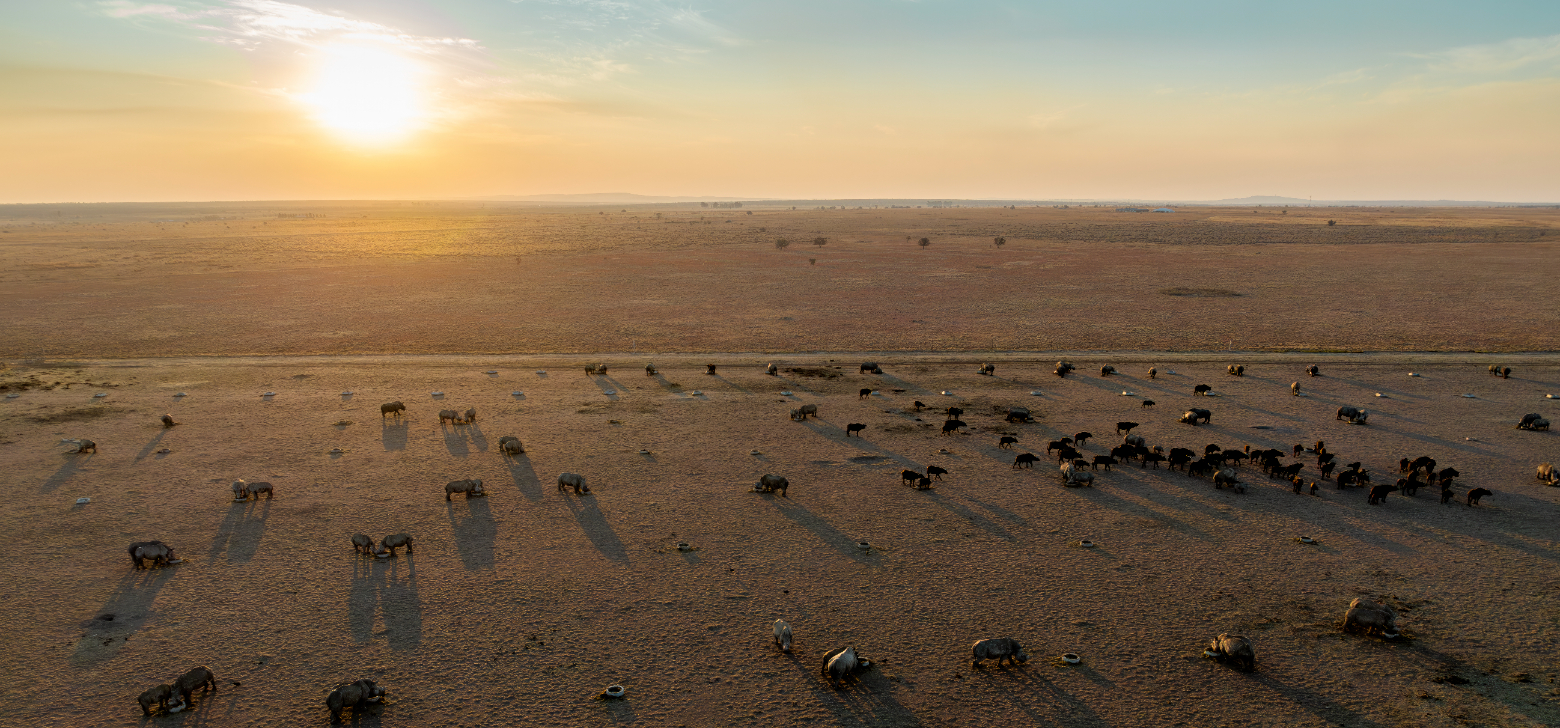
In 2009, South African entrepreneur John Hume founded a rhino breeding farm outside Klerksdorp, South Africa, with plans to saw off and sell the animals’ horns. Rhinos have been hunted for hundreds of years, and their horns are used to make ornaments, jewelry, and medicine. Though most rhinos are killed before their horns are removed, their horns can grow back. Hume planned to lobby the South African government to legalize the horn trade so that rhinos could be bred and raised for their horns, and kept alive, which he hoped would curb the poaching and killing of rhinos in the wild. But he ran out of money before he realized his controversial vision. In 2023, the nonprofit African Parks purchased the breeding farm and transformed it into a sanctuary where the organization could begin to reintroduce the farm’s more than 2,000 rhinos to the wild.  
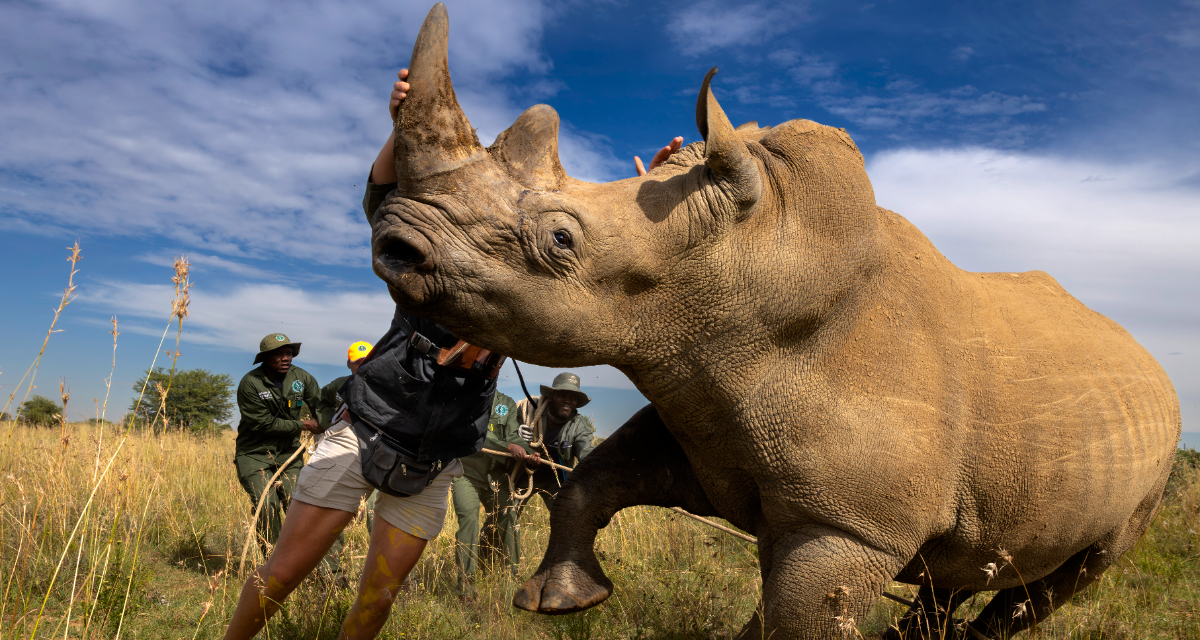
Employees with the conservation nonprofit African Parks help ease a sedated rhino to the ground during a relocation effort. (Photo Credit: Brent Stirton / National Geographic)

Stirton helped document the rewilding of these southern white rhinos as part of his project, “Planetary Health,” which was funded in part by the National Geographic Society’s Global Storytellers Fund and supported by The Climate Pledge. We spoke with him about the daunting effort of relocating the rhinos and what humans owe the animals we share the planet with.

This interview has been edited for clarity and length.

The Climate Pledge: Your work centers on planetary health. How do you define that?

Brent Stirton: Planetary health is about relationships and how nothing exists in isolation. When you put people into wild spaces, what happens to those spaces? How does the ecosystem change as a result? How is it preserved? Those are planetary health issues.

The Climate Pledge: How has the story about rhinos changed since you started documenting them?

Stirton: There's been a massive decimation of species, but we still have this reservoir of rhinos. The vast majority are southern white rhinos, but there are also black rhinos. The question we're asking is: Can we rewild the population out of the threat of extinction? How do you relocate 2,000 breeding rhinos to safe areas across the continent where they once lived? Today, those places can offer a safe harbor out of South Africa, which is the epicenter of the wild poaching epidemic.

In order to do this, you need air lifts, you need tremendous funding, you need education in the countries where these rhinos are going. The logistical costs alone are enormous. 


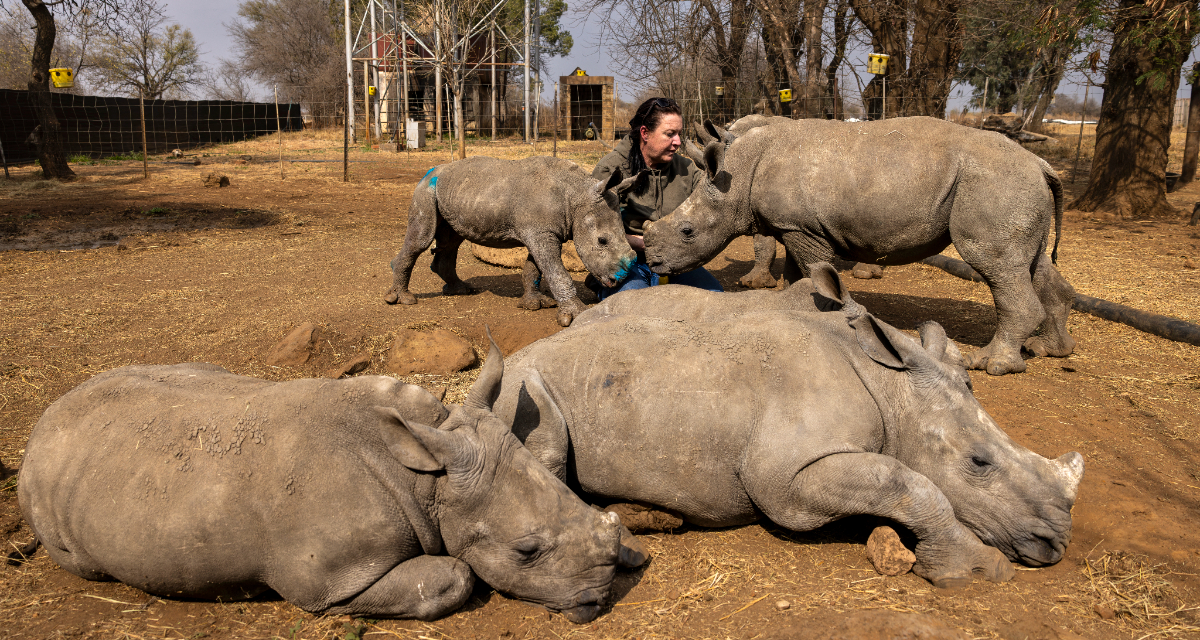
Caretaker Claudia Andrione provides rhinos with a mix of milk and supplements at the African Parks ranch. (Photo Credit: Brent Stirton / National Geographic)
The Climate Pledge: Who are the people working to protect rhinos?

Stirton: It's everyone from fundraisers and logisticians who map out these huge projects to veterinarians and people who are cutting off rhinos’ horns for the animals’ protection and physically pushing them into containers and driving 14 hours without a break to the next location—then getting up a day later and doing it all again. These are committed people, with a tangible goal in mind. [Editor’s note: Dehorning is a strategy used to curtail poaching; one study found the practice reduced poaching by 78%.]

Then there's the security. A lot of these people have had major incidents with poachers. People tend to think that a poacher is a guy with an old rifle or bow and arrow. In the case of the rhinos, it’s often organized, five- or six-man teams. A lot of these poachers are ex-military guys who are used to being in the field. This is dangerous, and one of the most intense exercises in translocation that's ever occurred. Rhinos, especially white rhinos, are like big babies—they’re naïve, almost innocent creatures. They don't really know what's going on, but they come in this enormously powerful body. Looking after them in transit, making sure they're calm, having a tranquilizer balance so they can recover quickly—that's all a very specialized skill. 
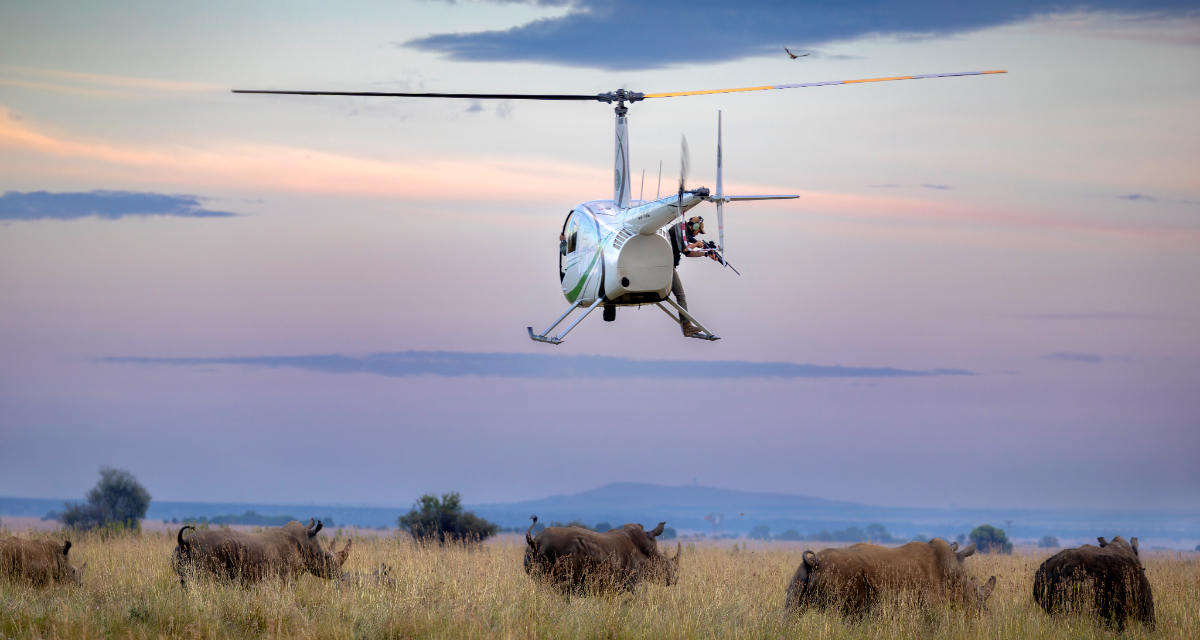
A key part of relocating rhinos involves tranquilizing the animals with a dart, shown here from the door of a helicopter. (Photo Credit: Brent Stirton / National Geographic)
The Climate Pledge: Why did you want to document this effort?

Stirton: It’s so difficult when you see these animals. I've gotten there and the animal is still dying. When you see that with a mature black rhino bull whose DNA is so important to the survival of his species and it’s happened because someone will pay big money to swallow the keratin that makes up rhino horns—that's a difficult one. 

When I look at the potential of this project, I wish African Parks every success. I think about the idea that humans are the apex species. That means we should be looking after everything else. Not feeling free to decimate or exploit, but rather to be a caregiver for animals like this and for environments.
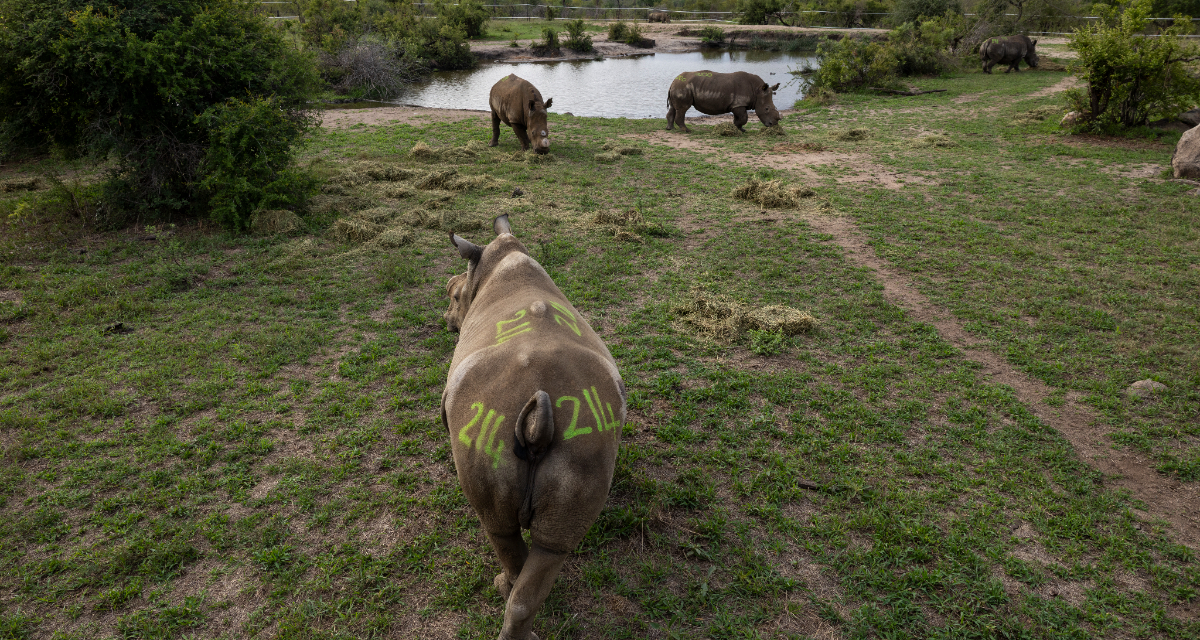
Spray paint helps identify which rhinos have received vaccines or medicine. So far, African Parks has relocated 20 populations of rhinos across Africa. (Photo Credit: Brent Stirton / National Geographic)

The Climate Pledge: What’s at stake if rhinos disappear?

Stirton: I don't particularly want to live in a world where animals are completely discounted, and their rights to exist are null and void. I also don't want to face my son, who is 8 years old, when he says: “What did you do about this? Why aren't these animals around?” Because those are the questions that we're going to get from future generations. 

We always say we're the dominant species on the planet. That's only one perspective. There's no reason why these animals can't exist and we can't enjoy the pleasure of interacting with them in their own environments. 

Read more from the National Geographic Explorers documenting the global climate crisis supported by the Global Storytellers Fund.

Find more of Stirton’s photographs on his website.

Read
Looking for more?
Climate Justice Extreme Weather
Father and daugther walking in their farm.

6 episodes

Future Forward documentary series

Peek through the lens of critically acclaimed directors as they reveal how Pledge signatories are innovating to safeguard our shared landscapes, resources, and potential.

View series
Corporate Responsibility Sustainability Goals
building collection image.

20 episodes

Just Back From

Get timely reflections on topical sessions and guest speaker perspectives from climate action events and landmark conferences hosted globally throughout the year.

View series
Climate Action Net Zero
people walking in a building.

10 episodes

Why We Signed essay series

Explore the many reasons companies from every industry have committed to net-zero carbon emissions by 2040, making matters of real urgency their business.

View series