Dec 9 2025 - Seattle, WA, USA

Seattle artist brings eye for water, mountains, and depth to Climate Pledge Arena this NHL season

Climate Pledge Arena Innovation

By Jessica Bernhard

/

Writer and Editor, Amazon Sustainability

“A call to look, see, and think about the environment is always driving me,” Kelda Martensen said.

Every hockey season, Climate Pledge Arena selects a Pacific Northwest artist to design a merchandise collection with net proceeds benefitting One Roof Foundation’s environmental justice pillar, which works to ensure kids have safe places to play, clean air to breathe, and clean water to drink.

“We’re excited to work with a wide range of artists with different backgrounds from the Pacific Northwest,” said Amazon Sustainability Creative Director Quinn Ianniciello. “The single requirement for the program is that the artists are interested in expressing their artwork through the lens of the climate crisis, and that their artwork can translate well into unique designs—like Kelda Martensen’s collages and prints.”

This year’s artist is Martensen, who specializes in collage prints using woodblock, letterpress, screenprint, and monotype printing processes. We sat down with her to learn more about how climate and the environment shape her work, how caregiving and teaching inspire her art, and her favorite pieces from the new collection.

This interview has been edited and condensed for clarity.

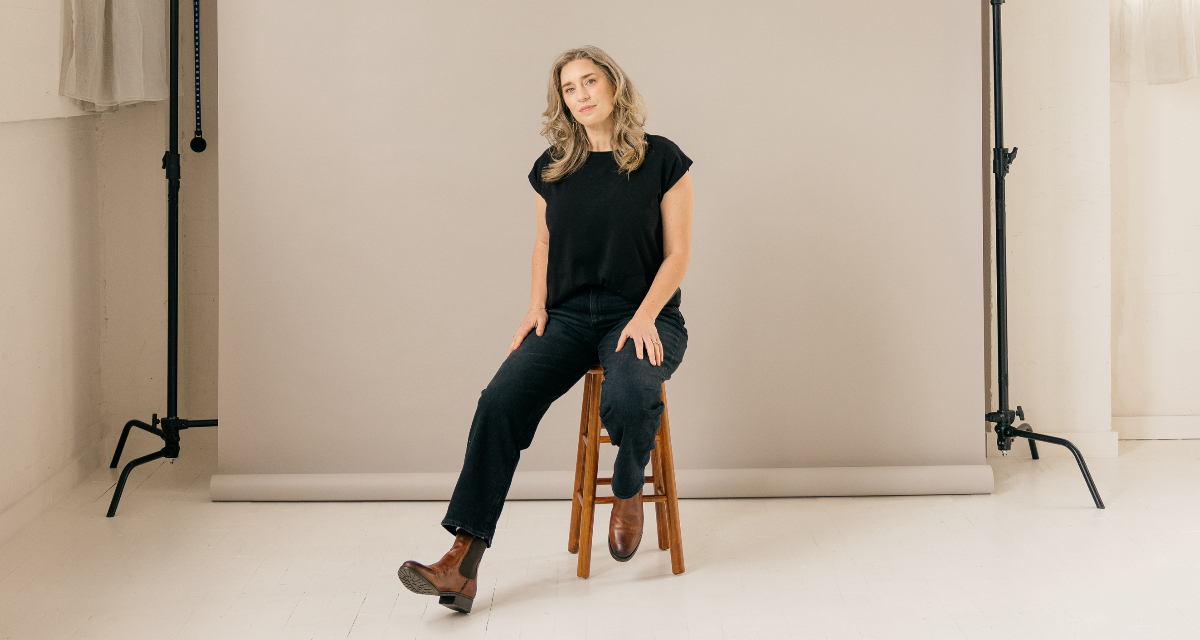
Portrait of Kelda Martensen
Early influences from growing up in Gig Harbor, Washington, appear in Martensen’s work as a visual artist, educator, and mom.

You grew up in Gig Harbor, Washington, influenced by your dad’s woodshop and work building boats and your mom’s music. Can you point to where some of those early, Pacific Northwest influences show up in your art?

My home was filled with music, both from the record player and my mom, who played a lot of piano and guitar. She gave me an early love of lyrics and songwriting, and from there I grew to love poetry. Music taught me that artists can address big ideas in abstract and poetic ways.

I was also heavily influenced by the boatbuilding community I grew up around, and specifically my dad’s woodshop. As a printmaker, I use many of the same carving tools that I grew up watching my dad use.

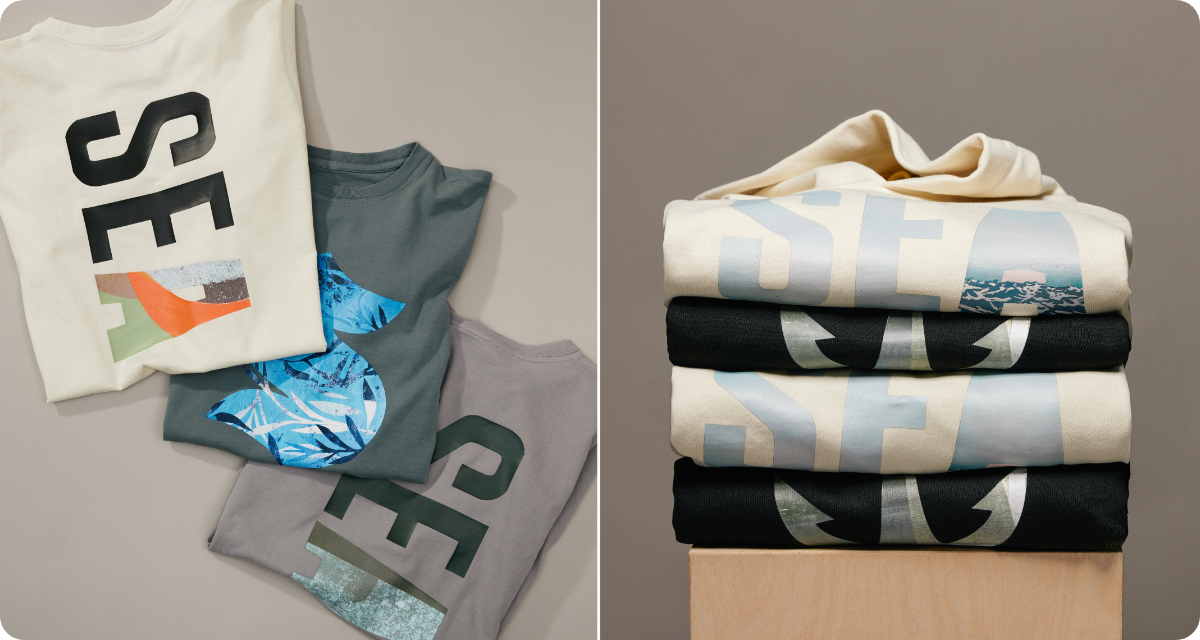
One explicit nod to boatbuilding in this collection is the “SEA” logo on the off-white hoodie—the negative space in the middle of the “A” is a photograph of a patch of marine paint over a light blue boat hull.

My parents encouraged me to work with my hands and I’m so grateful for that.

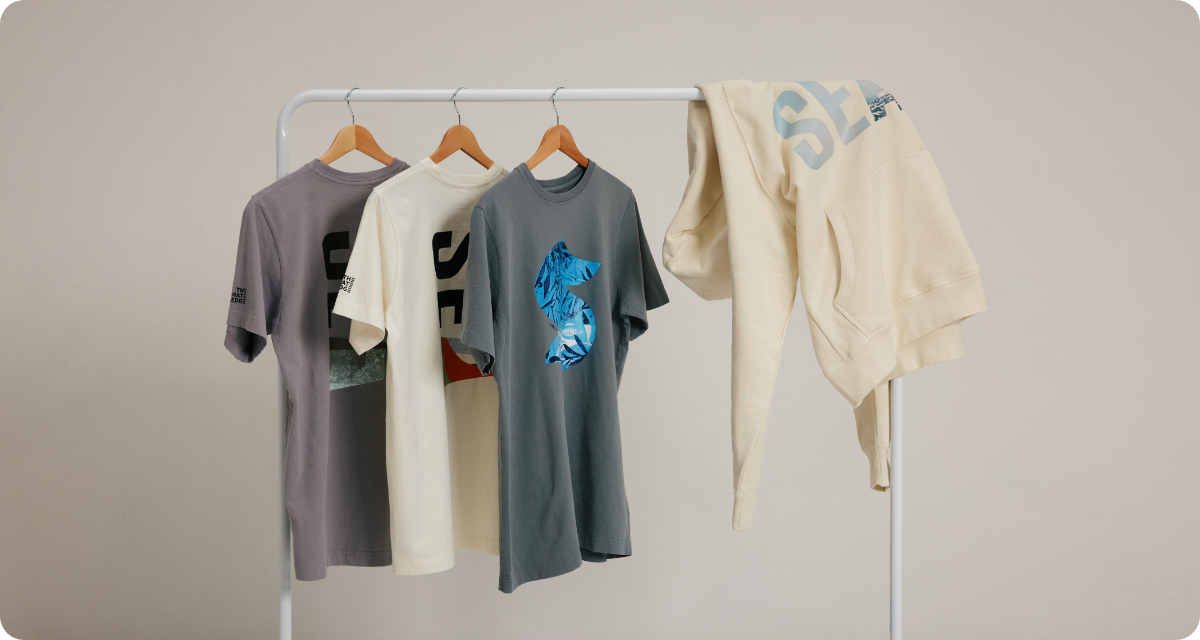
Martensen brought the tactile, layered feeling of her collages to the merchandise she designed for Climate Pledge Arena.

How would you describe your designs for Climate Pledge Arena to someone seeing them for the first time?

My starting place is as a printmaker. Everything you see in my work has gone through a press in some way—I ink up a carved or altered plate and run it through an etching press which transfers the ink to paper. From there, I cut and collage the prints into compositions. I try to create an illusion of depth in my work so that there appears to be space beneath the surface.

I wanted the merchandise to feel tactile and layered just as my works on paper do. I love the way the Kraken plays on that idea of what’s beneath. It’s a fun connection between my work and the team identity.

“I love the way the Kraken plays on that idea of what’s beneath.”

Your work references geological forms, figurative gestures, plant life, and climate. Can you talk a bit more about how you weave these themes into your work? How are they present in the designs you created for Climate Pledge Arena?

I played with these designs to achieve an abstracted and strong sense of water, plant life, and atmosphere. For example, the blue and white woodcut waves at the bottom of the “A” in the “SEA” graphic can be read as the choppy surface of the water, or a mountain range. I was also thinking about ice on a water’s surface when I created the bright blue “S” on the grey tee. I wanted to capture the coming of winter, when fallen leaves get trapped in ice as a pond freezes.

Throughout working on this project and thinking about the color palette, I thought a lot about the sky, and what it tells us—whether it’s hazy and foreboding during smoke season, clear and bright with incredible visibility, or the range of grays we all know well.

You maintain sustainable practices in producing your work. Can you talk about what that entails?

I try to be mindful of how to reuse, repurpose, and buy less. I don’t throw much away when it comes to art materials, which can be challenging in terms of storage. I try to think: “How can I use this again? What stories does it already have?”

I’m influenced by my father who kept and reused everything he worked with. Growing up witnessing his tremendous respect for the material rubbed off on me. I try not to look at things as disposable but as a physical and permanent part of our world. How can we respect and reuse them?

Do you have a favorite design from the collection?

I’m thrilled with how they all turned out and it’s hard to choose a favorite. I love the bright blue “S” of leaves encased in ice because it feels tactile and because of the way the collage element was preserved in the final product.

The off-white hoodie featuring the “SEA” graphic is meaningful, as the woodcut I used to create the waves has shown up in several of my works throughout the years. And, if you look closely at the anchor graphic, there are layers of woodcut, intaglio (a technique that involves engraving), monotype and almost all the forms of printmaking I use.

I was also excited to see the T-shirt with the small, square collage on the front and the “SEA” letters on the back, as that one feels most like my works on paper. The T-shirt with the small Kraken “S” on the front and the large “SEA” on the front was really fun to design, too.
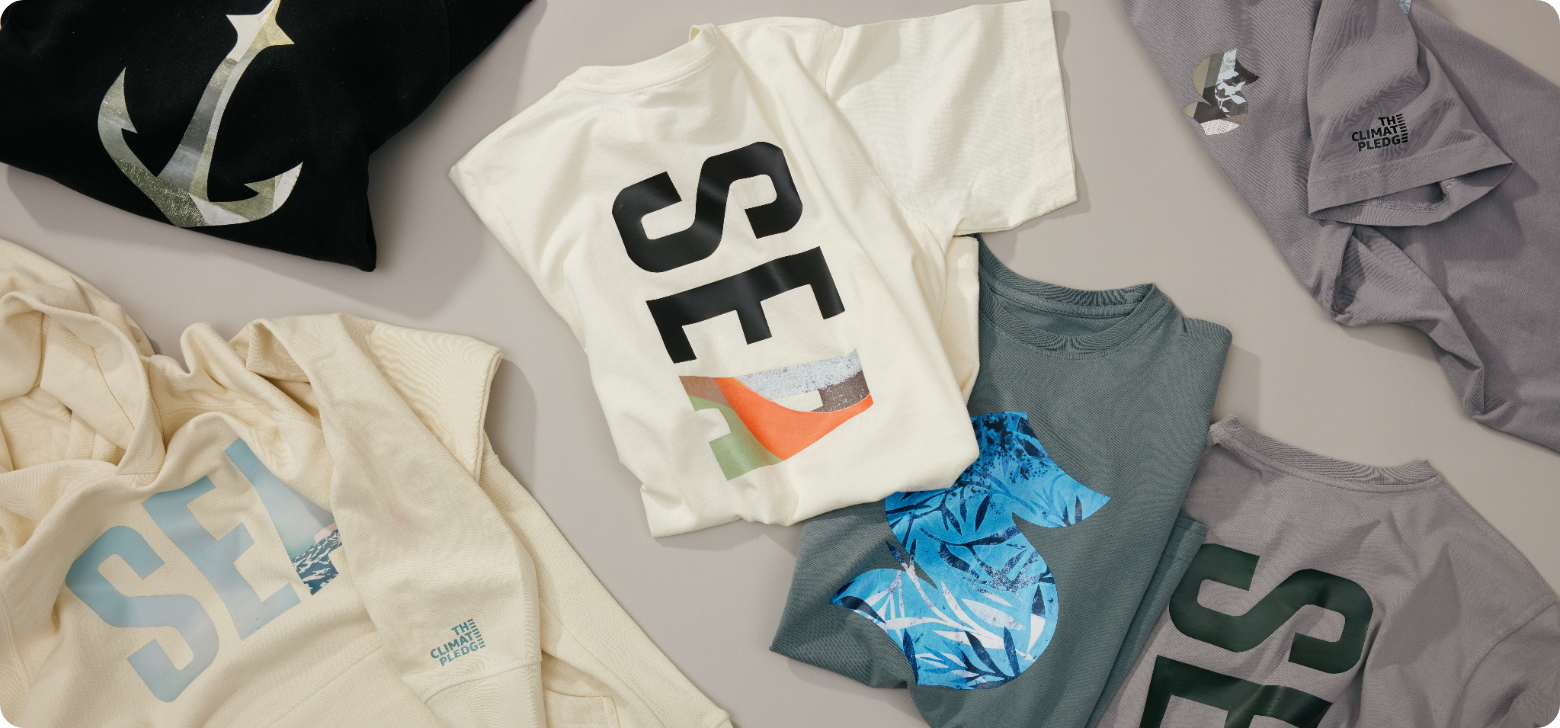
Martensen struggled to choose one favorite design from the collection. She pointed to the bright blue “S” of leaves encased in ice on the grey T-shirt, among other designs.

You are also a mom and an educator. Can you talk about how generative, caregiving roles influence your experience as an artist?

Being a mother and an educator while also sustaining a career in the arts feels like a constant conversation. There is no finish line—no one way to do it—and the realities and responsibilities of all three roles change so frequently that to stay in the game you are forced to continually reevaluate, shift, and adjust.

As a parent and educator, I want to model keeping a creative life at the center of everything I do. We don’t have to passively accept the way this world is, or how we are told to think. Being creative is an important act of resistance. I have my students and my children to thank for continuing to inspire and challenge me to clarify and broaden my perspectives.

Climate Pledge Arena is the world’s first net-zero carbon certified arena. Is it meaningful for you to collaborate with a venue that is at the forefront of climate action?

Every interaction I’ve had with The Climate Pledge and the Kraken team has felt collaborative and community-minded. It’s a special organization that understands how art and climate justice are interconnected. I hope other corporations can follow suit and I’m honored to be a part of it.

What are you working on now? Are there any projects you’re particularly excited about?

I spent the spring, summer, and fall building a backyard studio, and I couldn’t be more excited about it. I’ll be moving in over the winter and will start working toward a solo show of works on paper next year at J. Rinehart Gallery in Seattle.

Kelda Martensen’s collection for Climate Pledge Arena is available on site near the living wall installation, and online for the duration of the Kraken’s 2025-2026 season. She teaches full time at North Seattle College in the Art Department. Her artwork is available at keldamartensen.com. You can also find her on Instagram.

Read our previous coverage:


Photography by Kara Wallace DeGooyer.