Aug 19 2026 - USA

How six Climate Pledge signatories are turning net-zero ambitions into carbon reductions

Carbon Neutrality Innovation

By Kiesha Clayton

/

Principal, The Climate Pledge

Amazon, Ørsted, HP, Lime, Brooks Running, and To Do Green report measurable progress across multiple sectors.

No one company can cut carbon emissions at the scale needed to best protect our planet. That’s why The Climate Pledge exists: to bring together more than 700 companies committed to reaching net-zero carbon emissions by 2040. And those signatories are showing real, measurable progress, from electrifying vehicle fleets and decarbonizing supply chains to redesigning products from the ground up.

The following achievements have been shared with us directly by each Climate Pledge signatory.

Ørsted: Shifting from coal to carbon-free energy

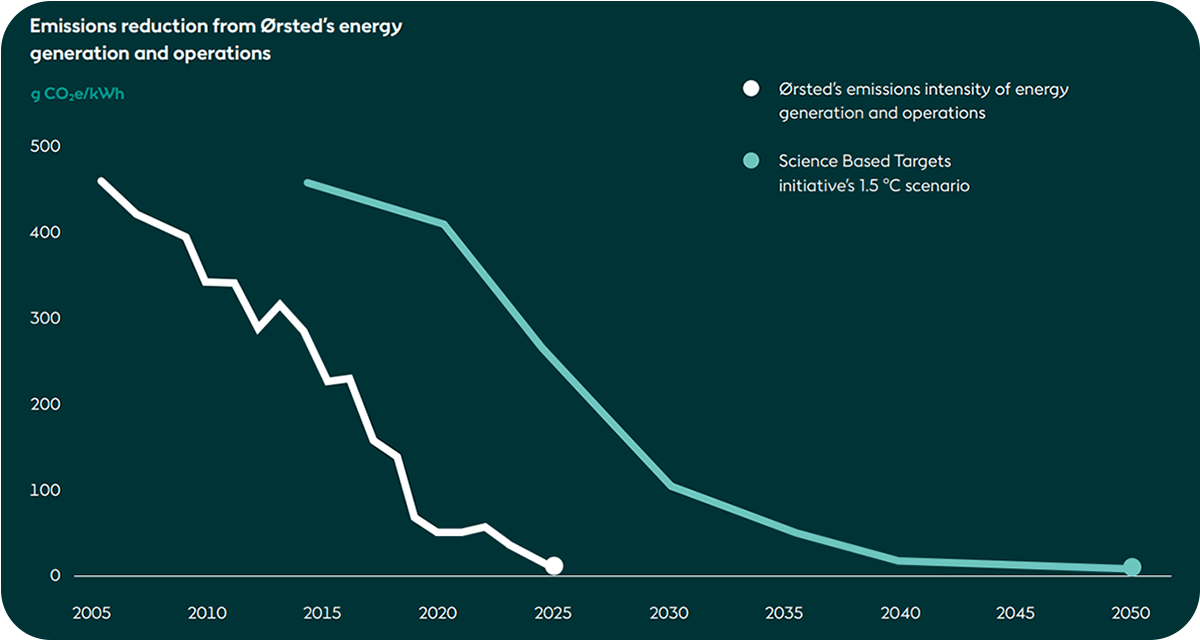
Two decades ago, Ørsted was one of Europe’s most coal-intensive utilities, and today the company is considered the global leader in offshore wind. By the end of 2025, it had reduced its Scope 1 and 2 emissions intensity by more than 98% from its 2006 baseline.

The numbers behind that shift are striking: 99% of Ørsted’s total energy production now comes from renewable sources, up from 17% in 2006. The company has built 18.3 gigawatts of offshore wind capacity, including more than 2,500 turbines—enough to power the electricity consumed by about 31 million people. And since 2021, nearly all of Ørsted’s capital expenditure (99%) has aligned with the EU taxonomy for sustainable activities, reflecting a full reorientation of its investment strategy around clean energy.

In 2025, Ørsted met its Scope 1 and 2 emissions intensity target.

Ørsted is now targeting net-zero carbon emissions across its entire value chain and embedding climate governance structures across its broader business to drive Scope 3 reductions. 

Read more about Ørsted’s progress.

HP: Decarbonizing the full value chain

Since 2019, HP has reduced absolute Scope 1, 2, and 3 greenhouse gas emissions by 28%, lowering its total carbon footprint to 16.4 million tonnes of carbon dioxide equivalent in 2025.

“Reducing emissions at scale requires action across the entire value chain,” said Kevin Lo, HP’s climate, circularity, and responsible sourcing director. "We combine supplier engagement, renewable energy, circular product design, innovative business models, and transparent product carbon footprint reporting to drive measurable reductions.”

HP has expanded its Supplier Scorecard program, which evaluates suppliers on sustainability performance to ensure procurement decisions are aligned with HP’s climate goals. It was a founding sponsor of the Catalyze program with fellow Pledge signatory Schneider Electric to pool renewable energy demand across semiconductor and IT supply chains. HP also reached 66% renewable electricity across its global operations, and uses 100% renewable electricity in the United States. It has cut Scope 1 and 2 emissions by 44% since 2019, and 47% of materials used in HP products and packaging now come from reused, recycled, or renewable sources.

 Read more about HP’s progress.
Lime: Scaling shared mobility while slashing emissions 

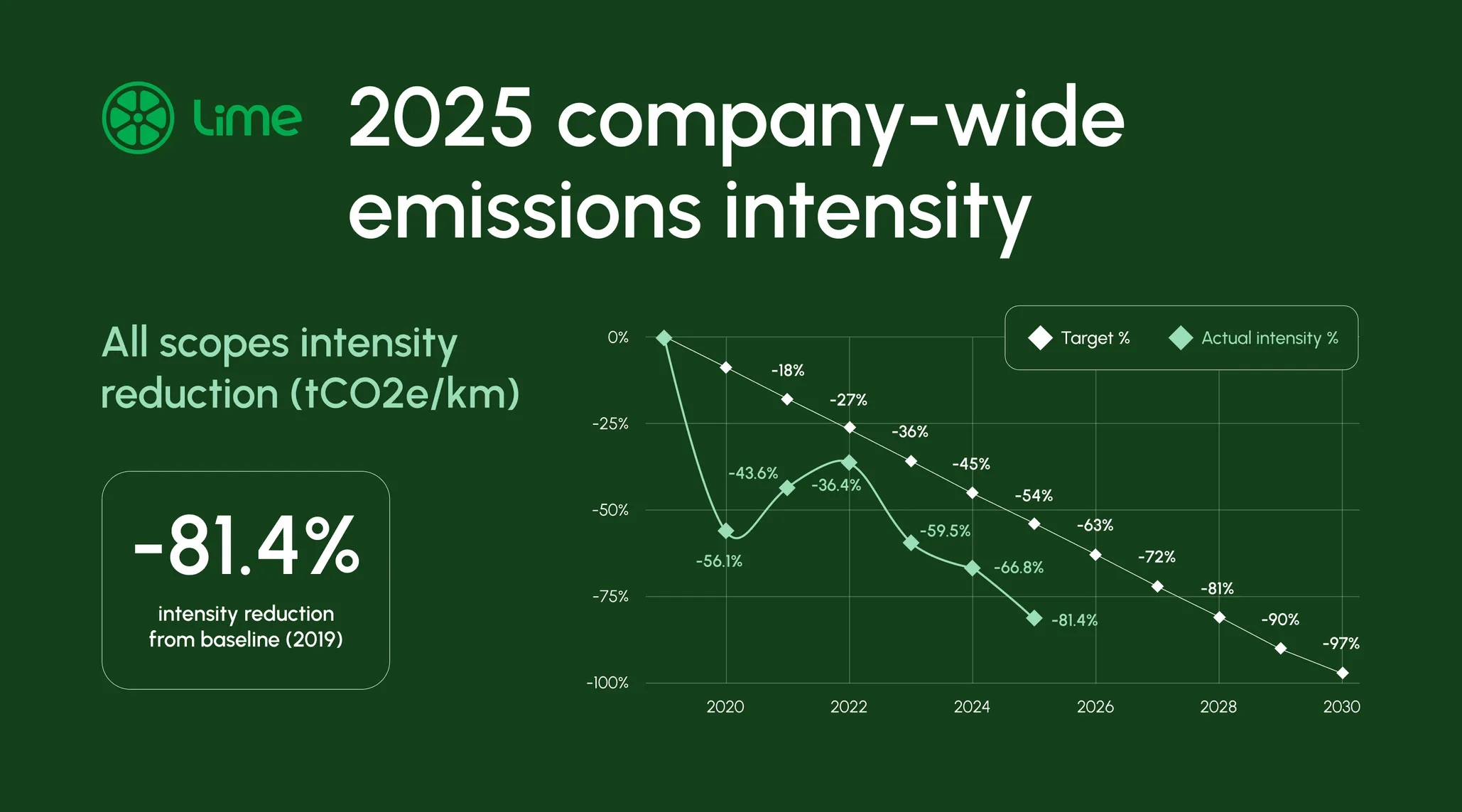
Can a company grow total kilometers traveled by 250% and cut emissions intensity by more than 80%? For Lime, the answer is "yes." The shared electric mobility company has achieved an 81.4% reduction in company-wide carbon emissions intensity compared to its 2019 baseline, putting Lime ahead of its science-based pathway to net-zero carbon by 2030.

Lime reduced company-wide carbon emissions intensity by 81.4% between 2019 and 2025.

“Transportation is one of the largest sources of climate pollution in cities around the world, which means scaling low-carbon alternatives is essential to meeting global climate goals,” said Andrew Savage, Lime’s sustainability and founding team vice president. “Our work is showing that shared electric mobility can serve more riders and become even more carbon efficient at the same time at scale.”

That progress reflects sustained investments in renewable electricity, electric operations vehicles, lower-carbon sourcing, vehicle longevity and repair programs, circularity initiatives, and lower-carbon logistics. For cities grappling with transportation emissions, one of the largest sources of climate pollution in urban areas, Lime’s trajectory is a signal that shared electric alternatives can scale and become more carbon-efficient simultaneously.

Read more about Lime’s progress.

Brooks Running: Proving that lighter footprints start at the factory

Brooks Running believes in the transformative power of the run, and it’s applying that energy to its climate commitments, turning incremental factory-level gains into a trajectory toward net-zero carbon. In 2025, the company reported a 9% year-over-year reduction in Scope 3 greenhouse gas emissions and a 17% reduction since its 2021 baseline.

By working directly with factory partners to transition to clean energy sources, Brooks Running is tackling its largest emissions—in production. It’s a straightforward strategy with compounding results: Each factory that switches to renewables permanently lowers the carbon intensity of every shoe leaving the floor.

Read more about Brooks Running’s progress.

To Do Green: Electrifying logistics from first mile to last

Diesel has long dominated logistics. But in Brazil, To Do Green is rewriting the playbook. One of Brazil’s largest all-electric logistics operations, To Do Green runs a fleet of approximately 600 electric vehicles that have made more than 40 million deliveries.

“Fleet electrification is already a reality,” said To Do Green CEO Paula Simões. “The future of logistics is here and in operation.”

To Do Green recently expanded into middle-mile operations, operating with only EVs across the full logistics cycle: first, middle, and last mile. It’s an end-to-end proof point that zero-emission logistics isn’t a future ambition—it’s a present-day operation.

Read more about To Do Green.

Amazon: Decoupling growth from emissions at scale

Since Amazon co-founded The Climate Pledge in 2019 and became its first signatory, the company has reduced its overall carbon intensity by 38%, even as its business has expanded, growing 156%. 

Amazon’s electric delivery fleet is a tangible example of its work to reduce emissions, with more than 52,700 vehicles delivering 2.4 billion packages around the world in 2025 alone. Meanwhile, renewable energy sources matched 100% of the electricity consumed across Amazon’s global operations for the third consecutive year. 

On the supply chain side, which accounts for 76% of Amazon’s carbon footprint, the company engaged its top suppliers to join The Climate Pledge and set credible decarbonization targets. As of last year, 62% of these suppliers had plans in place, a 23% year-over-year increase. 

Read more about Amazon’s progress.

Learn more about The Climate Pledge.