Sep 9 2026 - Global

A new blueprint: Scaling mass timber to lower carbon emissions in industrial and logistics buildings

Buildings

By Ric Cochrane

/

Senior Business Development Manager, The Climate Pledge

A Climate Pledge joint action project aims to use large industrial buildings to make mass timber as common as carbon-intensive steel and concrete.

Key takeaways:  

  • Mass timber is a lower-carbon alternative to steel and concrete in building construction.
  • Signatories of the Pledge are coming together to standardize mass timber components across building types and signal interest to suppliers to increase production.  
  • Amazon, Prologis, Ryan Companies, and Trammell Crow are all Pledge signatories participating in the joint action project.  

For about a century, almost every big building has been constructed from concrete and steel. They’re strong and readily available—and making them produces an enormous amount of carbon emissions; according to the World Economic Forum, cement and steel are each responsible for roughly 7% to 8% of global carbon dioxide emissions. If they were countries, they would rank among the top emitters in the world. But there’s a way to build large structures with wood that’s less carbon intensive: mass timber, a structural alternative to steel and concrete that can reduce embodied carbon by up to 60%, according to the International Journal of Architectural Engineering Technology

A new joint action project is uniting signatories of The Climate Pledge to help make mass timber as common as construction materials like I-beams or batched concrete so that they can fit into many different building types. 
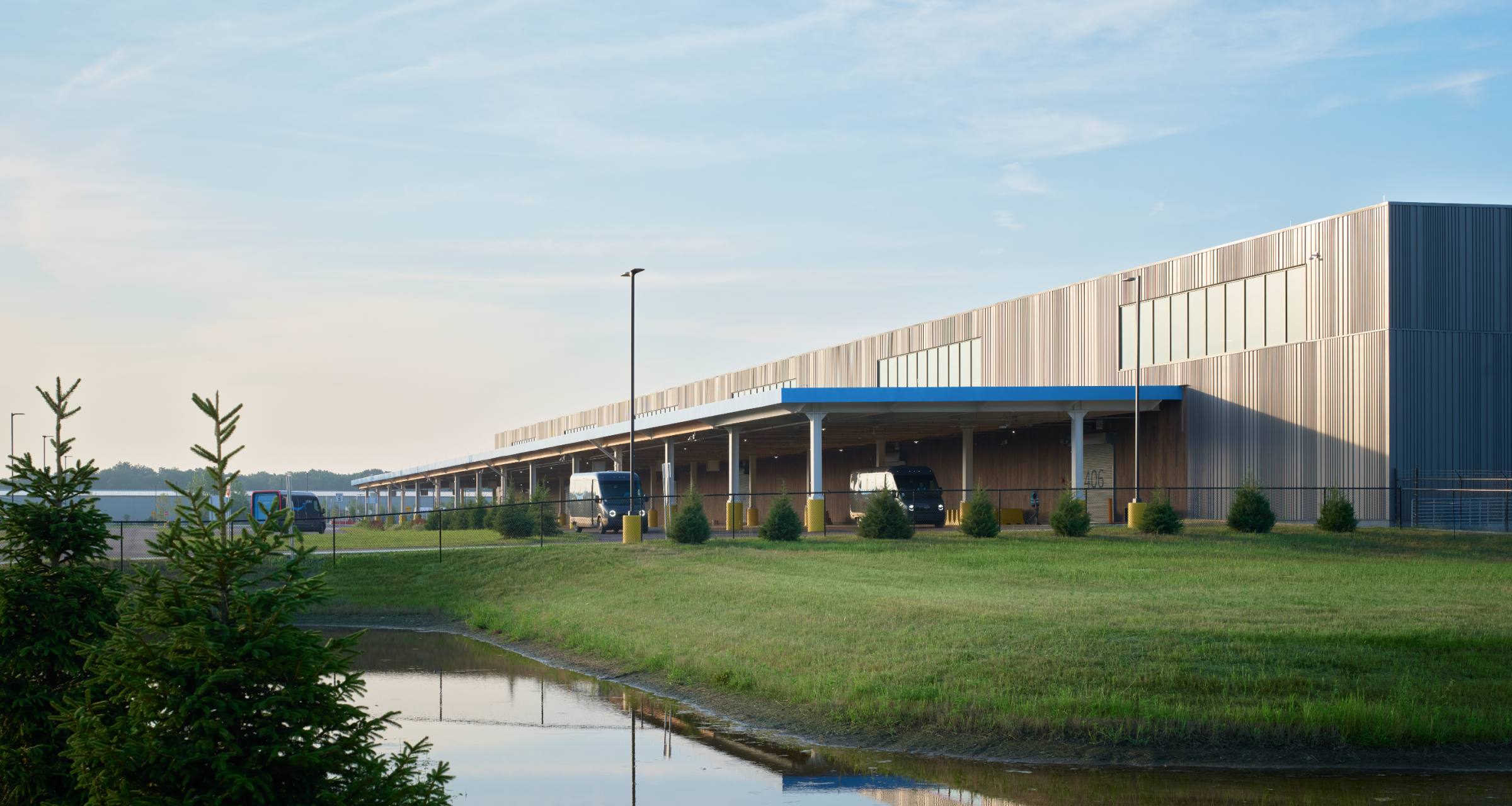
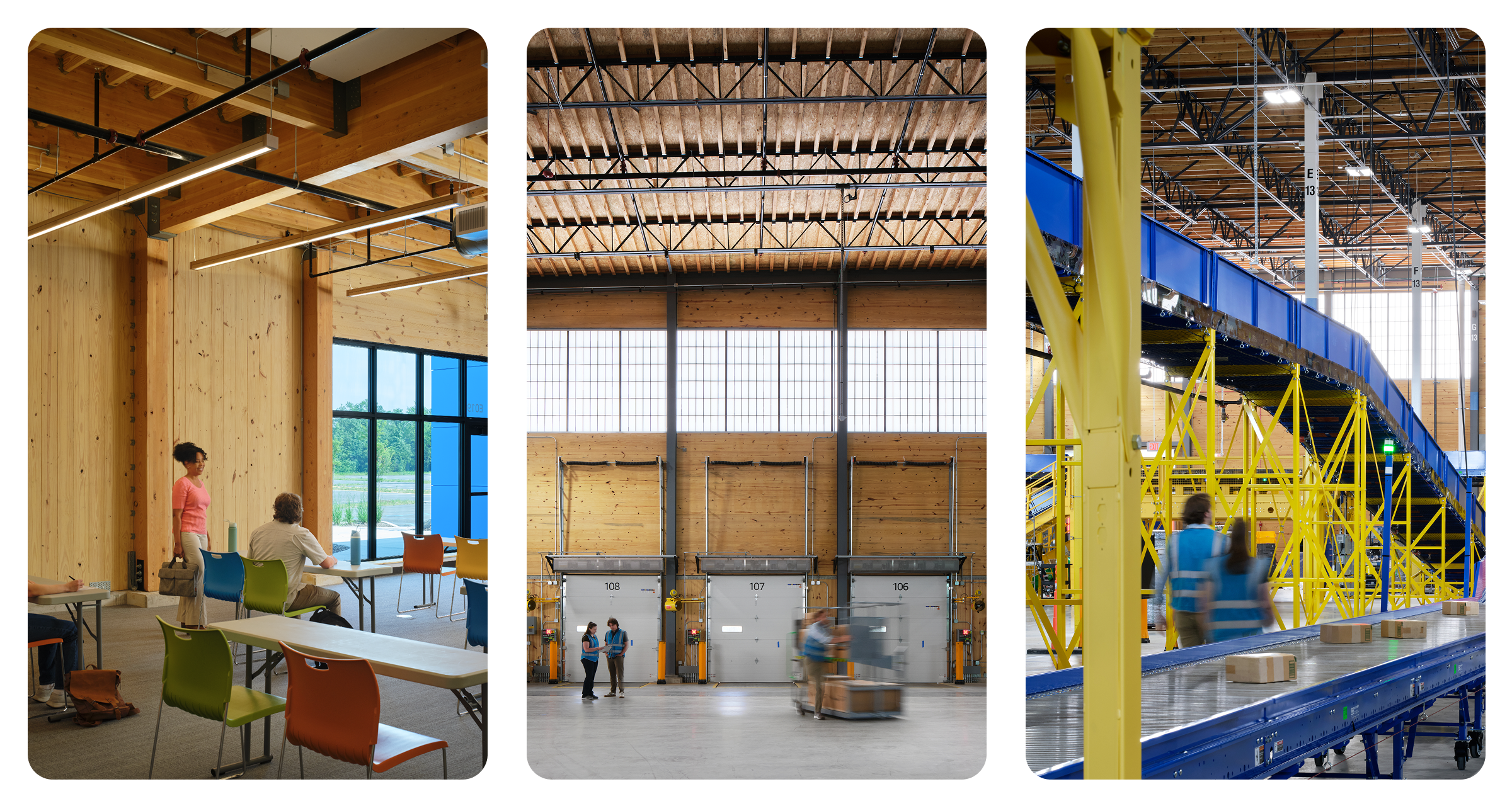
An Amazon delivery station in Elkhart, Indiana, with walls made from mass timber.

What is mass timber?  

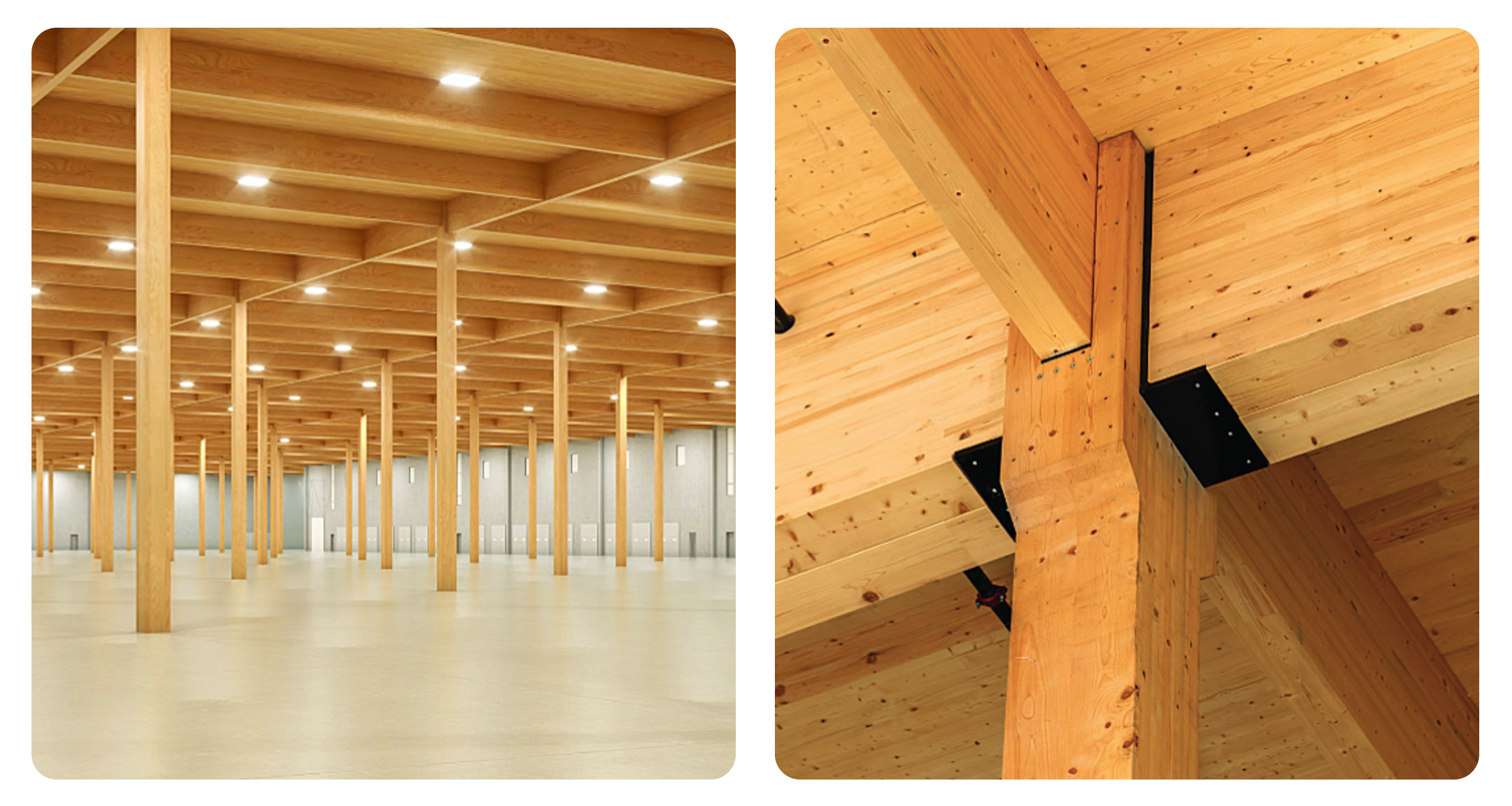
Mass timber is a modern category of engineered wood products—such as cross-laminated timber (CLT) and glulam—made by bonding layers of lumber together to create large, strong structural panels and beams that can replace steel and concrete in big buildings. Mass timber is primarily made from softwood trees such as spruce, fir, and pine. It’s similar to plywood you could buy at a hardware store but thicker and bigger—10-foot by 60-foot panels that are up to 8 inches thick, for example. 

Trees absorb carbon as they grow. So when we turn that wood into a building, the carbon stays locked inside for decades.

“We’re lowering the emissions of building materials, and we’re storing carbon,” said Elizabeth Correa, a senior sustainability technical infrastructure program manager at Amazon. “And if we manage our forests well, new trees grow back and absorb more. It’s one of the ways we can make the buildings we need while reducing effects on the climate.” 

Mass timber is relatively new, and almost every mass timber building is a custom design, with custom fabrication and custom installation. Competing with concrete and steel—supply chains that have been optimized over decades of use—means reckoning with cost premiums, supply chain reliability, and codes and regulations that haven’t caught up to mass timber. Scaling mass timber also means answering questions like “Who can manufacture it at scale?” and “Are construction crews familiar with using mass timber in all the places where we build?”

As Amazon planned the Elkhart delivery station, it looked for opportunities to reduce carbon emissions and improve sustainability beyond the building itself.
Increasing the use of mass timber requires three things, said Kristen Dotson, a principal on Amazon’s Sustainable Buildings team who works to help decarbonize Amazon’s buildings portfolio.

“The supply chain needs to scale for industrial-type applications, building codes need to continue evolving, and the cost gap needs to narrow,” Dotson said. “Private companies—especially those building at volume—play a critical role because their investments help encourage manufacturers' investment in new production capacity. But demand signals alone aren't enough. Private companies can also drive standardization across the industry, aligning on common panel dimensions and product specifications so that manufacturers can optimize production rather than custom-fabricating for every project.” 

How signatories are leading through joint action 

The Pledge created the mass timber commercialization joint action project to standardize mass timber building components across different building types, aggregate demand, and lower costs for everyone. The Pledge is working with RMI—a global nonprofit focused on market-driven decarbonization—ZGF Architecture, and Thornton Tomasetti to bring together large building portfolios and major builders including Amazon, Prologis, Ryan Companies, Trammell Crow, and Meta.

RMI thinks that a more standardized approach to mass timber can unlock economies of scale in design, manufacturing, and logistics.

“These savings can reduce cost, lead times, and risk for the full mass timber value chain, making mass timber accessible to a greater proportion of the market,” said Auri Bukauskas, buildings manager at RMI and project manager for the mass timber joint action project. 
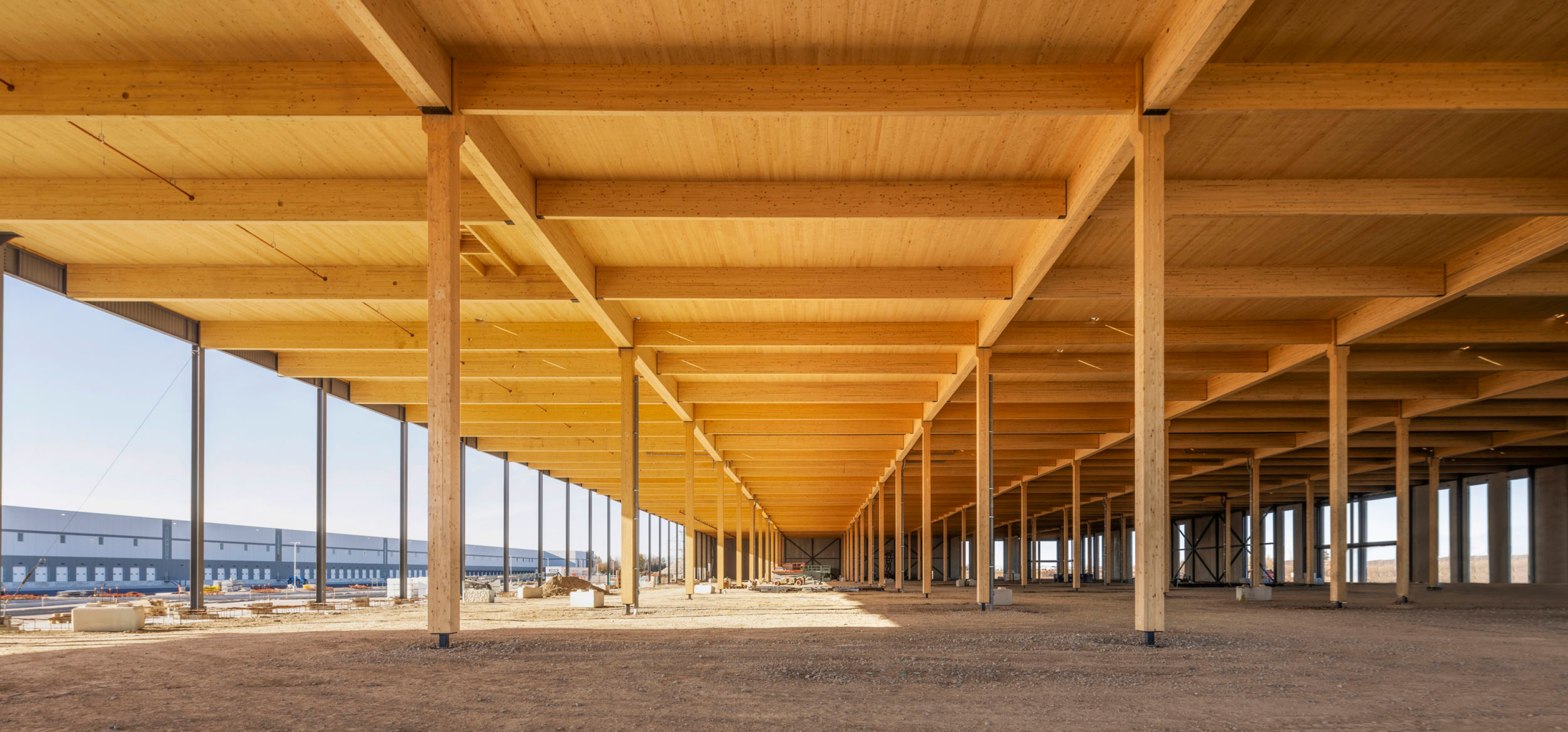
CLT on a Prologis building. Prologis is one of the Pledge signatories participating in this mass timber joint action project.
Participating companies have volunteered to share designs with RMI, which the technical team anonymizes and analyzes to identify CLT panel dimensions that will work for as many designs and as much of the volume for each design as possible. Signatories also want to ensure the wood for mass timber is sourced from forests that are well-managed to promote forest health and reduce fire risk and to support jobs in rural towns that depend on forestry and sawmilling. That means that a mass timber project might create revenue for forest management practices that reduce fire risk while bringing new business to sawmills in rural communities.

“It’s a building material that can be better for the climate than concrete and steel, good for forests, and good for communities,” Dotson said. “And the buildings themselves can be faster to build, with quieter construction due to fewer machines, and are honestly just more beautiful to be inside.”

Correa is the senior sustainability technical infrastructure program manager who leads the development and scaling of mass timber as a structural building material across Amazon’s logistics buildings and fulfillment warehouses. That involves building new supply chains and developing standardized design guidance that enables Amazon’s development and construction teams to incorporate mass timber into industrial facilities.
At a Prologis project in San Leandro, California, the Pledge signatory reused 60% of the existing structure and integrated lower-carbon concrete and mass timber.
“To scale, we need repeatable, standardized designs that work across geographies, seismic zones, and building typologies,” Correa said. “Without that, every project carries the cost and risk of bespoke engineering.” 

This is how steel and concrete became ubiquitous: through codified, repeatable approaches that reduced cost and risk over time. But no single company can move the entire supply chain alone.

“Joint action projects help companies with large building portfolios to align on common specifications so that manufacturers don't have to retool for every customer,” Dotson said. “It means sharing learnings about fire performance, structural design, and cost so that the whole industry moves faster together. It's a win-win for building owners, designers, and manufacturers.” 

Learn more about mass timber commercialization joint action project.